

Geothermal’s Expanding Role in Federal Energy Planning
/Written by Joanna Salvucci and Dawn Schilling, PE
Geothermal energy is an emerging national priority as the U.S. looks for reliable, clean energy solutions that strengthen the grid and support long‑term infrastructure needs. With the U.S. Department of Energy (DOE) ramping up investment in next‑generation geothermal technologies, new funding and opportunities are opening for organizations capable of evaluating and delivering complex, ground‑sourced systems. PHE’s experience with geothermal concepts across federal sites offers a practical perspective on how this resource is being assessed and applied in diverse settings.
DOE is reshaping how geothermal fits into the country’s long‑term energy strategy, highlighting its ability to provide consistent, weather‑independent thermal energy for buildings, campuses, and mission‑critical facilities. While DOE’s recent $171.5 million commitment focuses on advancing field‑scale testing and improving subsurface understanding, these investments reflect a broader federal effort to expand geothermal’s role beyond traditional applications and encourage wider exploration of where geothermal solutions may be feasible. As agencies revisit modernization, resilience, and energy‑performance priorities, geothermal is increasingly part of the conversation.
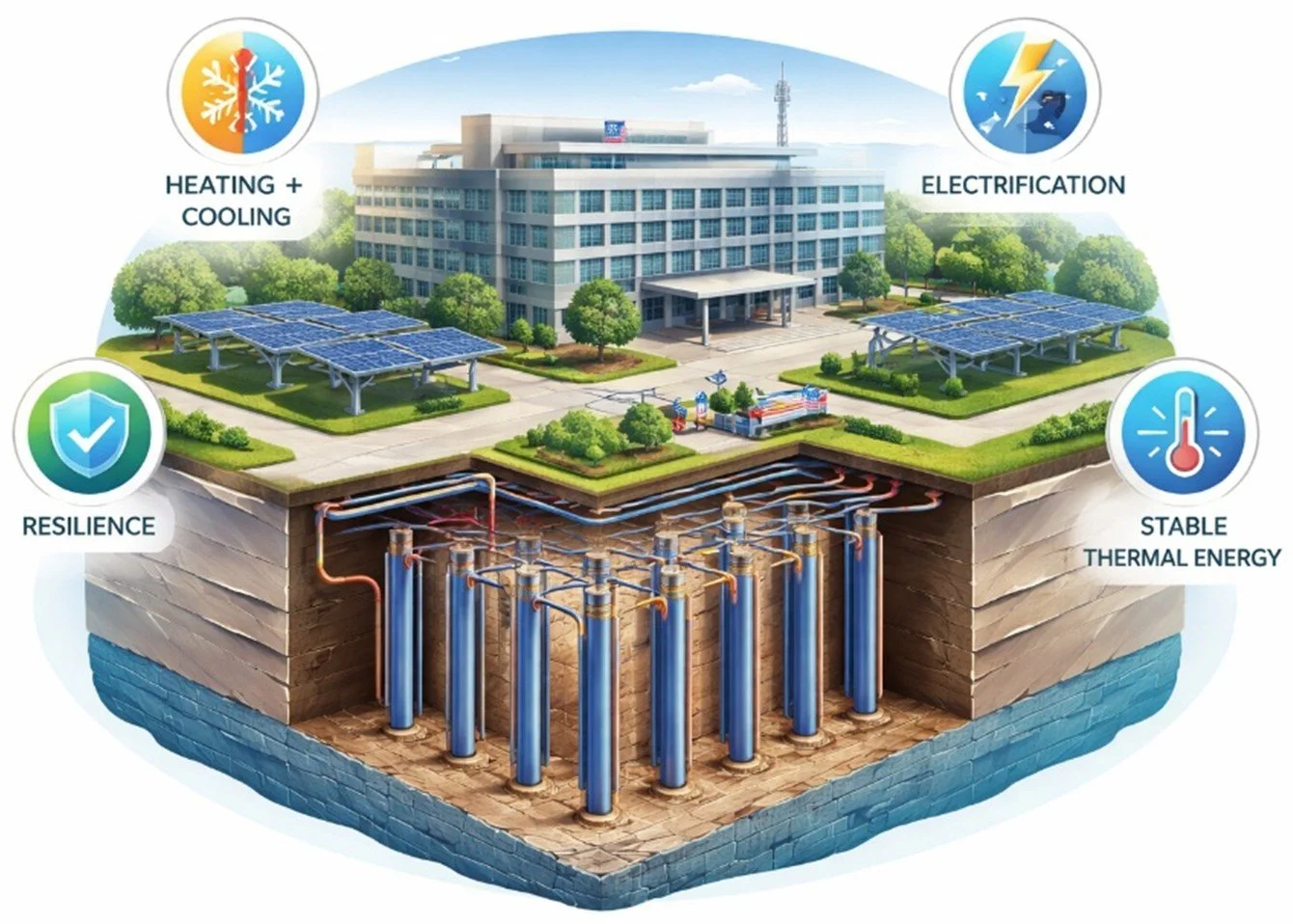
Image AI Generated
PHE Project Spotlights
PHE’s geothermal experience centers on integrating these complex energy systems into large federal modernization efforts while navigating environmental compliance, stakeholder engagement, and technical uncertainty.
Mine Water Geothermal Concept — Mike Mansfield Federal Building and U.S. Courthouse, Butte, Montana
At the Mike Mansfield Federal Building and U.S. Courthouse, the United States (U.S.) General Services Administration (GSA) explored an innovative geothermal concept that would draw heat from mine water in the historic Original Mine—avoiding the need for hundreds of boreholes. PHE led the planning-level environmental surveys, property research, and a public engagement process, synthesizing findings into a clear 35% Study that informed GSA’s decision making and eventual NEPA document. When subsequent design build team investigations identified structural issues within the mine shaft that made the system unworkable, PHE guided GSA through the pivot to a conventional natural gas system and its NEPA implications (the project was documented as a categorical exclusion). The project demonstrates PHE’s ability to evaluate novel decarbonization concepts objectively and provide agencies with actionable pathways—even when feasibility findings redirect the project.
Complex Borefield and Solar Integration — Denver Federal Center, Lakewood, Colorado
PHE also supported a private client and GSA in preparing the Environmental Assessment for one of the largest planned geothermal bore field installations on a federal campus—roughly 2,900 boreholes integrated with a major solar PV expansion. Our team evaluated potential impacts across the Denver Federal Center’s extensive natural and built environment, assessed effects, including potential impacts to and conflicts with existing underground utilities and historic buildings, and ensured the geothermal and solar investments aligned with federal environmental requirements. The project highlights PHE’s capacity to guide complex, campus scale clean energy projects through environmental review and help agencies implement geothermal within broader modernization strategies.
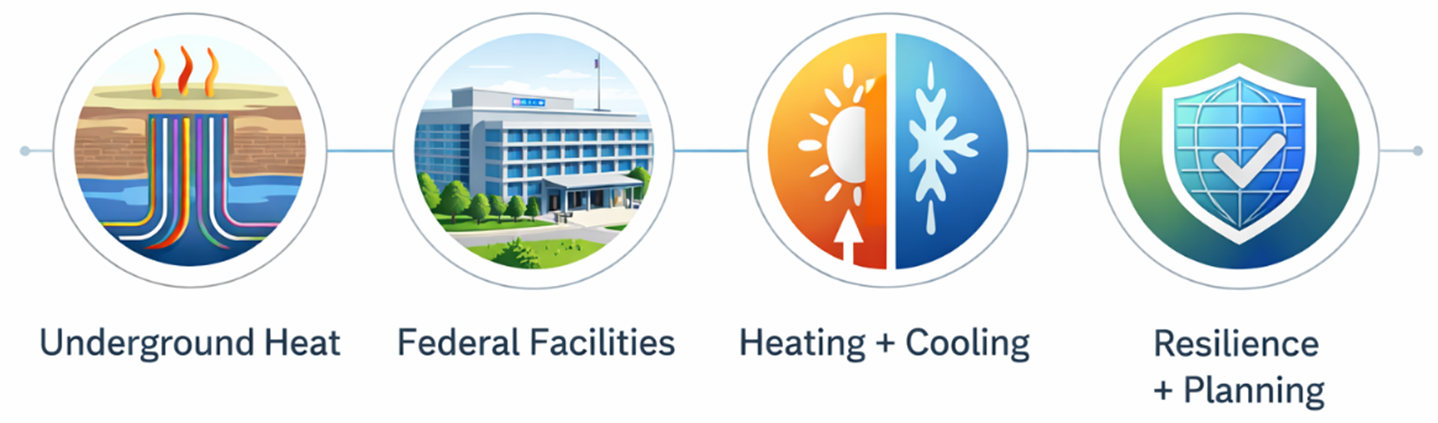
Image AI Generated
Looking Ahead
As geothermal gains national momentum, agencies and project sponsors are increasingly examining where it aligns with reliability, sustainability, and long term lifecycle priorities. DOE’s push to advance geothermal technologies is expanding the range of potential applications, prompting more organizations to include geothermal in early planning and feasibility evaluations.
A DOE analysis suggests skyrocketing geothermal capacity nationwide from four gigawatts to over 300 gigawatts by 2050. Beyond its applicability to large-scale utility installations and power plants, geothermal is becoming viable for use across military installations, campuses, and communities where 24/7 reliability and predictable lifecycle performance are demanded.
PHE’s recent project work shows how careful assessment, transparent evaluation of novel concepts, and clear environmental pathways can help decisionmakers understand when geothermal is the right fit — and when it isn’t. As interest grows, geothermal will continue to evolve from a specialty consideration into a standard part of the energy planning conversation.
PHE is a national consulting firm that specializes in environmental planning for Energy, Defense, and Civilian infrastructure. For any questions or for more information, please reach out to Dawn Schilling, PE, AICP at dawn.schilling@phe.com.
