

Is America’s Nuclear Resurgence Finally Taking Shape?
/Authored by: Brad Bockstie and Kate Kopp
After years of predictions about a nuclear comeback, policy changes, private-sector commitments, reactor demonstrations, and new licensing milestones are beginning to turn the conversation into action.

Illustration generated with OpenAI
For years, a U.S. “nuclear renaissance” has seemed to be perpetually just around the corner. Nuclear power has long offered an appealing combination: large amounts of reliable electricity with very low operational carbon emissions. Yet high construction costs, long development schedules, regulatory complexity, fuel-supply constraints, and difficult project economics have limited new U.S. construction.
This time, however, something looks different. Electricity demand is rising, driven in part by data centers and other energy-intensive uses. Major technology companies are making long-term commitments tied to nuclear generation. Existing plants are being positioned to produce more power and remain online longer. Advanced reactor developers are reaching technical milestones, and federal policy is pushing for faster testing, licensing, and deployment.
Does that mean a new generation of nuclear plants is about to appear across the country? Not necessarily. But there is enough activity across several parts of the nuclear sector to suggest that the discussion is moving beyond policy aspirations and toward real projects.
Why Nuclear — and Why Now?
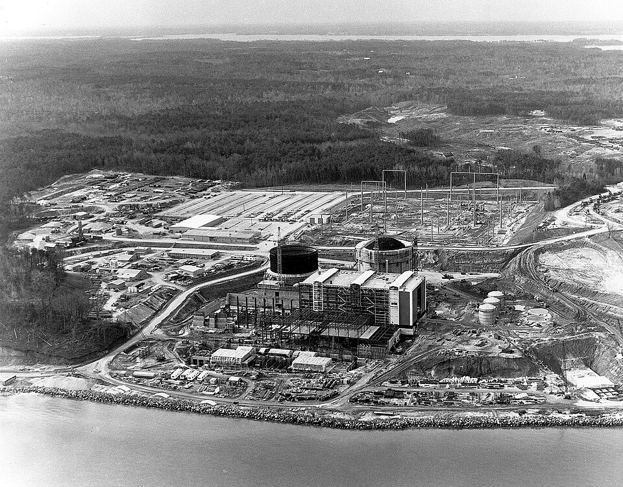
Calvert Cliffs Nuclear Power Plant during its original development, March 1971. Photo: U.S. Department of Energy / predecessor agency. Public
The renewed interest in nuclear energy is closely tied to a larger change in the U.S. power market: after years of relatively flat electricity demand, utilities and grid operators are planning for significant growth. Data centers are an important part of that story. The U.S. Energy Information Administration projects substantial long-term growth in electricity consumed by data-center servers, with the range depending on how quickly computing demand and equipment power requirements increase.
That growth puts a premium on generation that can provide large amounts of dependable power around the clock. Nuclear is not the only answer, and new nuclear projects still face significant cost, schedule, licensing, and supply-chain challenges. But the combination of reliability, high output, and low operational carbon emissions has made nuclear increasingly attractive to utilities, policymakers, and large electricity users.
The market is already responding. In September 2026, Amazon and Constellation announced a 20-year agreement that will support more than $3 billion in investment at Maryland’s Calvert Cliffs Clean Energy Center, including upgrades expected to add approximately 190 megawatts of generating capacity between 2030 and 2032. Days later, Google and Constellation announced another 20-year agreement supporting more than $4.3 billion in upgrades at 11 nuclear units in Illinois, Pennsylvania, and New Jersey, expected to add 890 megawatts of new capacity to the PJM grid.
Those deals illustrate an important part of the current nuclear story: the fastest path to more nuclear electricity may not always be a new reactor. Increasing output at existing plants — known as an uprate — can add generation while taking advantage of existing sites, transmission connections, workforces, and infrastructure.
From Policy Goals to Physical Milestones
Federal policy has also shifted sharply toward accelerating nuclear development. Four executive orders issued in May 2025 addressed reactor testing, Nuclear Regulatory Commission (NRC) licensing, deployment at national-security facilities, and the domestic nuclear industrial base. Among other goals, the orders call for facilitating an increase in U.S. nuclear capacity from roughly 100 gigawatts in 2024 to 400 gigawatts by 2050, supporting 5 gigawatts of uprates at existing plants, and having 10 new large reactors with complete designs under construction by 2030.
The orders also directed changes intended to shorten licensing timelines and created a Department of Energy (DOE) pathway to accelerate testing of advanced reactors. Under DOE’s Reactor Pilot Program, four advanced test reactors reached criticality by July 4, 2026, exceeding the program’s original target of three.
Criticality is an important milestone: it means a reactor has achieved a controlled, self-sustaining nuclear chain reaction. But the distinction matters. These demonstrations were conducted at very low or zero power and did not produce commercial electricity. They show technical progress and create data and experience that can support later development; they do not establish that a design is ready for commercial deployment.
A different milestone came in March 2026, when the NRC approved a construction permit for TerraPower’s Natrium project in Wyoming. The NRC described it as the first commercial reactor construction approval in nearly a decade and the first approval for a non-light-water reactor in more than 40 years. Here again, the milestone is significant but specific: a construction permit authorizes construction; it is not an operating license.
A Resurgence Is More Than New Reactors
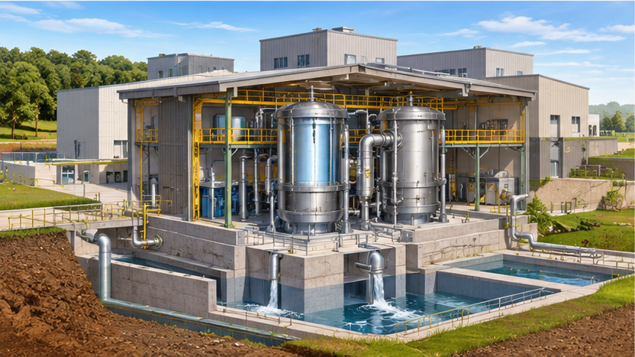
Conceptual illustration generated with OpenAI
One of the more interesting aspects of the current nuclear push is that it is occurring along several tracks at once. The United States is looking at how to extend and increase production from its existing fleet, restart selected closed plants, deploy smaller and more modular designs, and eventually build new large reactors.
That matters because the existing fleet remains central to the near-term picture. The average U.S. commercial reactor is roughly 44 years old, while the newest — Vogtle Unit 4 in Georgia — entered commercial service in 2024. Keeping existing facilities economically viable, relicensing them where appropriate, and safely increasing their output can affect the power supply much sooner than a large new-build program.
Advanced reactors could eventually broaden where and how nuclear energy is used. Small modular reactors and microreactors are being developed with different sizes, cooling systems, fuels, and deployment models, including potential applications at remote locations, industrial facilities, microgrids, and military installations. But “advanced,” “modular,” or “micro” should not be confused with commercially available. Each design still requires engineering, testing, licensing, financing, siting, construction, and ultimately operation.
What Happens When a Nuclear Concept Becomes a Project?
For environmental and engineering teams, the most consequential part of a nuclear resurgence may begin after the technology headlines. Turning a reactor concept, plant upgrade, or restart into an operating project requires a specific site, infrastructure, regulatory approvals, environmental review, and coordination with agencies with direct regulatory jurisdiction and the communities affected by it.
At an existing plant, increasing the maximum power output (uprate) may largely use established facilities and grid connections, but equipment changes can still affect cooling systems, water withdrawals and consumption, thermal discharges, construction staging, traffic, noise, waste management, and transmission infrastructure. Regulatory reviews may also be needed to address plant modifications and continued operation.
A new reactor can require a much broader site evaluation. Depending on the project, that can include land use, wetlands and floodplains, wildlife habitat, cultural and tribal resources, nearby communities, water availability, geology and seismic conditions, extreme-weather hazards, transportation routes, transmission connections, emergency planning, spent-fuel management, and eventual decommissioning.
Early coordination becomes particularly important because some of the information needed for environmental and permitting decisions cannot be developed overnight. Seasonal ecological surveys, water-resource studies, cultural resource investigations, stakeholder engagement, and coordination among federal, state, tribal, and local agencies can influence site selection and design decisions long before construction begins.
Momentum, but Not Yet Certainty
Illustration generated with OpenAI
The recent activity surrounding U.S. nuclear energy is meaningful precisely because it is occurring on multiple fronts: large electricity buyers are putting money behind long-term nuclear supply, existing plants are attracting new investment, advanced reactor developers are reaching testing milestones, a new non-light-water commercial reactor has entered construction licensing, and federal policy is explicitly pushing for faster deployment.
At the same time, it is important to distinguish between those milestones. A federal target is not a project schedule. Criticality is not commercial generation. A construction permit is not permission to operate. A power purchase agreement can improve project economics, but it does not eliminate engineering, licensing, environmental, financing, or construction risk.
That distinction may be the best way to understand the current moment. The U.S. nuclear resurgence is not yet a wave of completed new power plants. It is a growing collection of policy, technology, licensing, and market signals that are beginning to create credible pathways for more nuclear generation.
Whether those pathways ultimately produce a sustained nuclear expansion will depend on what comes next — and on the ability of project teams to translate momentum into safe, licensable, financeable, and environmentally responsible projects.
PHE has supported environmental analyses associated with nuclear facilities, including siting, environmental impact assessment, waste-repository review, and decommissioning — experience that informs our perspective on how energy projects move from concepts and policy goals to site-specific decisions. For any questions or for more information, please reach out to Fred Carey, PE at fredc@phe.com or Dawn Schilling, PE, AICP at dawn.schilling@phe.com.
