

Countdown to Compliance 2026: Your New Year Reporting Roadmap
/By Diego Santaella, Brad Bockstie, Erin Kouvousis, and Greg Jackson
With the start of the new year, facilities handling hazardous chemicals or generating significant amounts of hazardous waste face a critical window for regulatory reporting. Staying ahead of these reporting deadlines isn’t just about compliance—it’s about ensuring safety, transparency, and readiness for your community and workforce. This quick guide highlights what’s due, when, and why it matters.
Facilities handling hazardous chemicals or generating significant amounts of hazardous waste face multiple regulatory reporting deadlines in the first few months of the year. These include Emergency Planning and Community Right-to-Know Act (EPCRA) Tier II notifications and Biennial Hazardous Waste Reports, both due on March 1st. Read on for the details you need to keep your facility compliant and avoid costly surprises. If you need help navigating these requirements, the PHE team is here to assist with reporting strategies and compliance planning—reach out anytime.
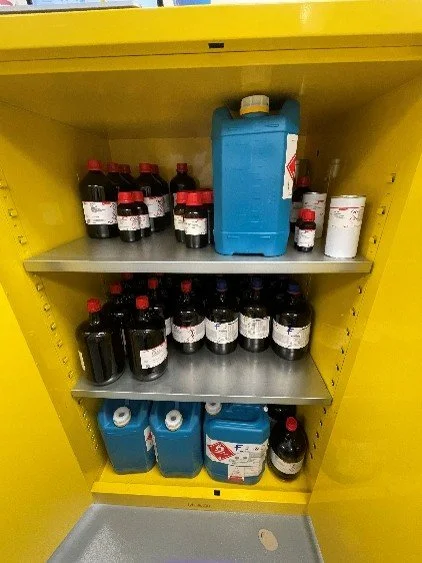
Photo Credit - Diego Santaella
The Fine Print: EPCRA Reporting Explained
What is EPCRA?
EPCRA is a federal law established in 1986 to help communities and authorities prepare for chemical emergencies. This law requires facilities that store or use hazardous substances to report pertinent chemical storage information to federal, state, and local authorities.
What are the EPCRA requirements?
Extremely Hazardous Substances are chemicals that could cause serious irreversible health effects from accidental releases. The EPA first compiled the list and subsequently incorporated it into EPCRA. To view the list of current EHS chemicals and their associated TPQs, visit eCFR Appendix A to Part 355.
Section 302 (Emergency Planning Notification) requires facilities that are in possession of certain listed Extremely Hazardous Substances (EHS) at or above their reporting threshold to notify their applicable State Emergency Response Commission (SERC) and Local Emergency Planning Committee (LEPC) of the quantity stored. These facilities must also appoint an emergency coordinator to work with the LEPC. The list of SERC contacts is available on EPA.gov; your SERC can help you find your LEPC. The reporting threshold for EHSs is 500 pounds or a specific Threshold Planning Quantity (TPQ), whichever is lower.
Section 304 (Emergency Release Notification) requires the proper authorities to be notified upon sudden release of an EHS or a Comprehensive Environmental Response, Compensation, and Liability Act (CERCLA) hazardous substance at or above its Reportable Quantity (RQ) within a 24-hour period. It is required that the facility provide immediate verbal notification, followed by written notification, as soon as practicable to the SERC, and LEPC. After notification, the facility must conduct a follow-up written report to the SERC and LEPC. Release of CERCLA hazardous substances may also require a similar immediate notification to the National Response Center (NRC) under CERCLA Section 103.
CERCLA hazardous substances refer to those included on the following lists:
- Clean Water Act Hazardous
Substances
- Clean Water Act Toxic Pollutants
- Clean Air Act Hazardous Air
Pollutants
- Resource Conservation and
Recovery Act Hazardous Wastes
Section 311 (Material Safety Data Sheet [MSDS/SDS] Submission) requires facilities to provide the SERC, LEPC, and local emergency responders with Material Safety Data Sheets (MSDSs), or Safety Data Sheets (SDSs), for hazardous chemicals. This is applicable when a facility stores any OSHA hazardous chemicals at or above 10,000 pounds, or any EHS at or above 500 pounds or their TPQ, whichever is lower. Facilities must submit either a copy of each MSDS/SDS, or a list of hazardous chemicals grouped by hazard category. The Section 311 submission is usually a one-time reporting requirement; however, facilities with any significant changes to their initial submission must resubmit within 90 days of the change.
Significant changes that may trigger a Section 311 update can include:
Acquiring new hazardous chemicals above reporting thresholds.
Increasing inventory of existing hazardous chemicals above reporting thresholds.
Removing reportable hazardous chemicals from the facility or lowering the quantity stored below the reporting threshold.
Discovering new significant information about an existing reportable hazardous chemical (i.e., change in hazard classification, composition, or other health and safety information requiring a new MSDS/SDS).
Section 312 (Tier I/II Chemical Inventory Report) requires annual reporting (also known as a Tier II report) on the chemical quantities and storage conditions at each facility. While reporting thresholds vary by state, a Tier II report is generally required when a hazardous chemical is stored in quantities exceeding 10.000 lbs or, in case of EHSs, the applicable TPQ or 500 lbs (whichever is lower). Tier II requires that the following information be reported for each individual reportable chemical stored on site: chemical name, Chemical Abstract Service (CAS), maximum amount stored on site, average daily amount, storage container type and quantity, storage conditions, precise location of chemical storage, and the contact information for emergency coordinators. Tier II reports must be submitted to the SERC, LEPC, and the local fire department.
Section 313 (Toxic Release Inventory [TRI] Reporting) requires qualifying facilities to measure and publicly report their annual releases and waste management of toxic chemicals. In order to determine if a facility is required to report, they must meet all three of the following conditions:
Industry sector – Federal facilities, as well as facilities in the manufacturing, electric utilities, petroleum storage and refining, mining, and hazardous/toxic waste treatment sectors, are subject to TRI reporting. Facilities outside those listed may still be subject to TRI. A list of covered industry sectors can be found on EPA.gov.
Employee threshold – employ 10 or more full-time employees.
Chemical Activity Threshold – manufacture at least 25,000 pounds, process at least 25,000 pounds, or otherwise use at least 10,000 pounds of toxic chemicals over the calendar year. A list of covered chemicals and chemical categories can be found at EPA.gov.
Facilities meeting the criteria must submit a TRI Form R to the EPA for each TRI-listed chemical it manufactures, processes, or otherwise uses in quantities above the reporting threshold. Reporting requirements for the TRI Form R include detailed facility information, chemical name, quantities manufactured/processed/used, chemical transfers, releases to the environment (i.e., air emissions, water discharges, land disposal), and waste management activities (i.e., treatment, recycling, energy recovery, disposal and transfers to other facilities).
Certain facilities may be eligible to submit a simpler TRI Form A Certification Statement for a chemical if their total annual reportable quantity for that chemical is 500 pounds or less, and their manufacturing, processing, or other use of that chemical does not exceed 1 million pounds in a calendar year.
Deadlines for EPCRA submissions
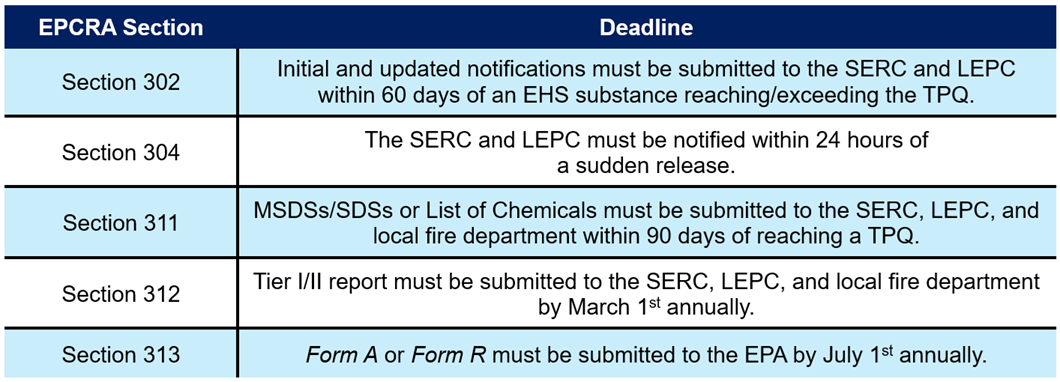
Table 1 outlines the deadline requirements for each section of EPCRA, if applicable.
Hazardous Waste Biennial Reporting
Large Quantity Generators are facilities that generate 1,000 kilograms (2,200 pounds) or more of hazardous waste or more than 1 kilogram (2.2 pounds) of acute hazardous waste per calendar month.
While EPCRA pertains to the storage of hazardous chemicals, the Resource Conservation and Recovery Act (RCRA) pertains to the management of solid waste. Section 3002(a)(6) of RCRA requires EPA to develop a program for hazardous waste generators to report the nature, quantities, and disposition of hazardous waste generated at least once every two years. To meet these requirements, EPA requires certain generators of hazardous waste to submit a separate Hazardous Waste Report to the appropriate state agency or EPA regional office by March 1 of even-numbered years (i.e., 2026). These Hazardous Waste Reports, also known as Biennial Reports, must be submitted by the facilities that met any of the following criteria during the prior calendar year:
Met the federal definition of a large quantity generator (LQG) under the Resource Conservation and Recovery Act (RCRA);
Treated, stored, recycled, or disposed of RCRA hazardous wastes; shipped hazardous wastes offsite to a RCRA-permitted treatment, storage, recycling, and disposal facility; or received hazardous wastes from off-site hazardous
waste generators; orMet the definition of a reverse distributor.
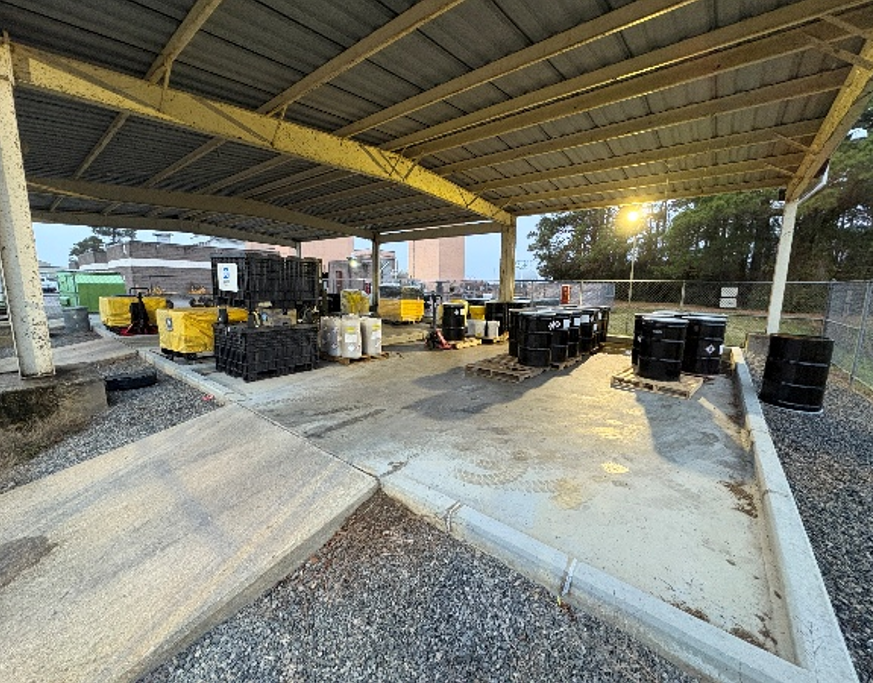
Photo Credit - Diego Santaella
For example, a generator that was a LQG in 2025 must submit a Biennial Report by March 1, 2026. This applies even if the facility was an LQG for a single calendar month during the reporting period.
A Biennial Report contains the following forms:
RCRA Subtitle C Site Identification Form. Please note that this form should also be used to notify the EPA if your facility had previously qualified as an LQG but is now a small quantity generator (SQG) or very small quantity generator (VSQG) and is no longer submitting a full Biennial Report.
Waste Generation and Management Form for all hazardous waste used to determine the facility’s generator category.
Waste Received from Off-Site Form (if applicable).
Off-Site Identification Form (if required by the state in which the facility is located).
EPA Form 8700-13A and associated Biennial Report forms complete the Biennial Report package, which is used to complete the required biennial reporting of all hazardous waste generated at the facility. Please note that some state agencies may require annual reporting, so it’s important to understand the regulations applicable to your facility and location. The EPA guide to completing the Biennial Report is available on EPA.gov.
If you have questions, need help navigating EPCRA reporting requirements or would like more information on the services PHE offers with respect to compliance, our team is here to assist - please reach out to Greg Jackson at greg.jackson@phe.com.
